


Case #2: Szenario Analysis for Strategic Management with SystemiC Constellation
- Marco Schlimpert

- Jul 18, 2025
- 8 min read
Updated: Nov 24, 2025

What happens when three business scenarios collide? A case Study
How you"test drive" different future scenarios using Company Foresight and discover which strategies will truly be successful. A real case study from the chemical industry.
Strategic Management: A rEAL case study from 2022
The Management Board of an international corporation faced a critical decision. Three different scenarios for the remaining fiscal year were on the table, each with different impacts on markets, employees, and business results. Traditional analysis had reached its limits: Excel models provided numbers, but no answers to the crucial questions of corporate leadership.
Which market scenario will materialize? How will the company respond? And most importantly: Where are the blind spots that could destroy all planning?
In this complex situation, the company decided on Company Foresight with systemic constellation including remote viewing. What emerged was not only surprising but also revealing: The supposedly "best" scenario turned out to be the most problematic for leadership.
Understanding the power of scenarios
Scenarios are powerful tools of strategic planning. They help companies think through different future trajectories and prepare for various developments. However, traditional scenario planning has its limitations: It often remains too abstract, doesn't consider human factors, and overlooks systemic interactions. Moreover, it's based on possibility thinking rooted in historical data.
Modern business strategy requires more than rational analysis - it needs emotional intelligence and the ability to penetrate complexity. Additionally, the competence to "sense the future" is becoming increasingly important. This is where the perceptual phenomenon of remote viewing comes in, through which information from the future, so-called emerging information, can be accessed. Entrepreneurs often refer to this information as "gut feeling," "intuition," or a tingling bodily sensation.
Here lies the strength of systemic constellations combined with remote viewing: They make not only the scenarios themselves visible but also their effects on all levels of the organization - from leadership to employees, from markets to business results, and predict developments.
how does a scenario constellation work?
1. Preparation and system elements
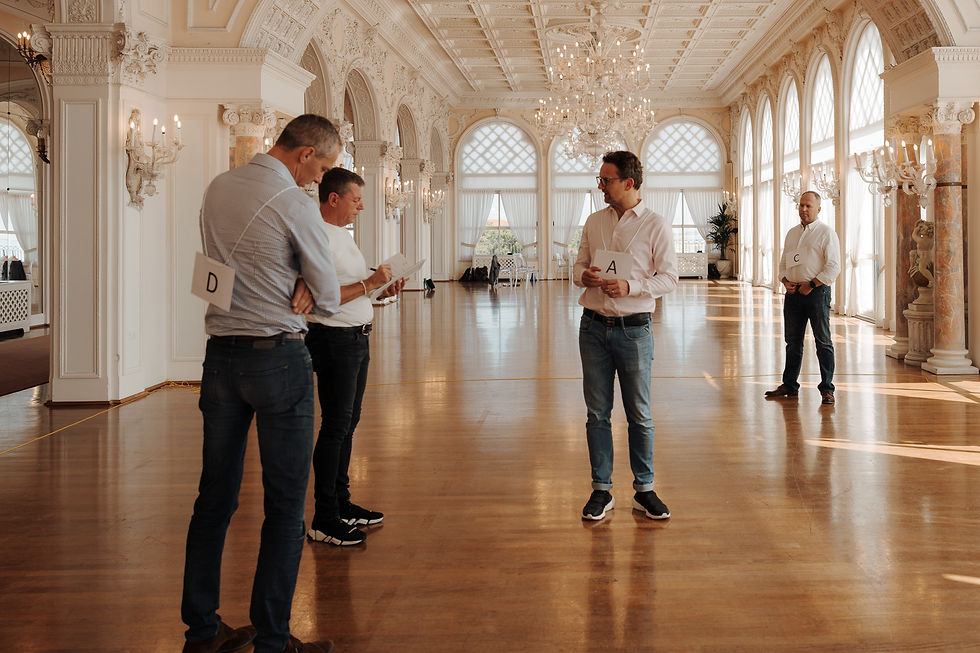
In our practical case, the following elements were identified:
Product Market 1 and 2 (external market)
Energy Market (critical cost factor)
Middle Management (operational leadership)
Employees (operational level)
EBITDA (business results)
Executive Board (strategic leadership)
Company (overall organization)
Scenario (respective future variant)
Joker (the "missing element" that makes the difference)
2. Concealed implementation
Crucial: The representatives didn't know which scenario they were currently playing through or whom they were representing. They received only numbers and were guided by their intuitive perception.
3. Capturing time dimensions
Each scenario was examined at three different time points:
Present (current state)
Q4 2022 (medium-term development)
Q1 2023 (further development)
These time jumps made the dynamics of the scenarios and their impact on the system visible.
Systemic Constellation: the surprising insights
Szenario 1: the stagnation scenario
Scenario 1 represented moderate market development - neither particularly good nor dramatically bad. For the strategy department, it seemed predictable and safe. However, the constellation revealed a fatal weakness: The employees became uncertain and "dizzy," the managers behaved passively and hesitantly, even though they actually wanted to be active. The board was exhausted and showed little interest.
The time jumps showed: The longer this scenario persisted, the stronger the stagnation became. The system froze into inactivity, while the scenario itself became increasingly impatient and irritated that nothing was moving. Only in Q1 2023 did the situation relax somewhat - Product Market 1 could look at the scenario for the first time, and the board felt drawn back into the field. Product Market 2 remained stable throughout
Szenario 2: Das crisis scenario
Scenario 2 represented the most challenging environment - probably characterized by massive market collapses and external pressure. The scenario itself was "the most energetic" - excited, powerful, and wanted to "achieve something massive." Product Market 1 "saw black" and sensed that much external pressure would arise. Product Market 2 was not impressed by this scenario. The more resistance emerged, the more power the scenario gained.
The dramatic turn: Over time, the board even collapsed - a clear sign of overwhelm or exhaustion. The scenario became increasingly impatient and demanded everyone to act: "If you don't do anything, something terrible will happen." However, the company was convinced that "this scenario won't come" - a dangerous mixture of denial and reality refusal.
Szenario 3: the wishful scenario
Scenario 3 was the "friendliest" of all scenarios - probably characterized by stable markets and moderate growth. It approached very cautiously and didn't want to frighten anyone. The managers only now became active and "came into their power." For business results, it was perfect, and the company felt this scenario was "the most fitting."
But here lay the trap: In the first two scenarios, the managers behaved passively and hesitantly. Only in the "best" scenario did they become active. This meant: The company was only programmed for success, not for challenges. Over time, it also showed that the company became weaker when the scenario didn't fully "engage" - an indication of problematic dependence on optimal conditions.
the decisive factor: the joker
In all scenarios, the Joker played a central role - the element that "makes the difference." The constellation revealed that this joker had something to do with sustainability.
Energy, company, and scenarios felt strongly attracted to the joker. This was a clear indication that sustainability was not just a "nice-to-have" but a success-critical factor for all scenarios.
This is not about sustainability reporting or compliance, but about sustainability as an intrinsic part of the business model.

why conventional scenario planning falls short
Traditional scenario planning focuses on:
Quantifiable factors (revenue, costs, market shares)
External developments (market changes, regulation)
Rational assumptions with linear cause-effect relationships (if-then logic)
What is overlooked:
Human factors: How do leaders and employees react emotionally to different scenarios?
Systemic interactions: How do different organizational levels influence each other?
Hidden blockades: Which unconscious patterns can cause even good plans to fail?
Energetic dimensions: Which scenarios mobilize forces, which paralyze the system?
Emerging information: Information that works from the future, which we often title as "hunches."
Business intelligence and predictive analytics can show trends, but they capture neither the complexity of social reactions nor can they sense information from the future. This shows the importance of innovation in management consulting: The future requires new processes that integrate both analytical and intuitive insights.
practical insights for corporate leadership
1. make leadership crisis-resistant
The constellation clearly showed: The managers were only capable of action in the "best" scenario. In challenging situations, they behaved passively and hesitantly. This ambiguity tolerance was completely missing.
Consequence: Targeted crisis training and development of leadership competence for difficult times. Mentoring and leadership development are essential here. Especially in crisis management, it's important to create precise procedures with responsibilities that allow trust and confidence. Precise procedures bring security, thereby reducing often human micromanagement, which in turn creates trust.
Reality one year later: This insight proved prophetic. When markets actually came under pressure in 2023, exactly the patterns visible in the constellation showed: Middle management waited for instructions from above instead of acting proactively. Companies that had invested early in crisis leadership could react much better.
2. take board exhaustion seriously
In two of three scenarios, the board showed signs of exhaustion. This was a clear warning signal for either overload or overwhelm at the top leadership level.
Consequence: Systematic relief of the board through targeted development of crisis management routines. Especially in challenging situations, it's important to distribute tasks and responsibility across multiple shoulders. Away from micromanagement, toward trust and confidence.
Reality one year later: Indeed, several board members of industrial companies had to leave their positions at the end of 2023 and end of 2024. The constellation had indicated this development beforehand.
3. Activate employee potential
Interesting: The employees behaved more actively than the managers in crisis scenarios. They even wondered about the passivity of leadership.
Consequence: Involve employees more strongly in crisis management and promote their initiative.
Reality one year later: Companies that early set on decentralized decisions and employee empowerment instead of micromanagement showed significantly higher adaptability. The working level was often faster at developing practical solutions than the leadership level at making strategic decisions.
4. sustainability as success factor
The joker "sustainability" was of central importance in all scenarios. This was a clear indication that sustainability is not only ethically right but also business-critical. The corporate succession of the future will be significantly shaped by sustainable strategies.
Consequence: Develop sustainability as an intrinsic part of business strategy.
Reality one year later: The EU taxonomy regulation and new ESG requirements actually made sustainability the decisive competitive factor. Companies that had already strategically anchored sustainability could position themselves much better than those who only considered it "nice-to-have.".
new dimension of scenario planning
Systemic constellations open completely new possibilities for scenario planning that go far beyond traditional approaches. While conventional scenario planning primarily works with numbers, data, and rational assumptions, the systemic perspective makes the effects of different future scenarios visible.
Particularly valuable is the ability to capture systemic interactions. The constellation reveals how different organizational levels influence each other, where amplification effects arise, and where blockades form. These dynamics are made visible in their complexity without requiring elaborate analysis processes.
Furthermore, the method enables discovering hidden success factors - elements that are really decisive for success but are overlooked in traditional planning. The "joker" sustainability in our example was such a factor that proved business-critical long before this became visible in the numbers.
Finally, systemic scenario planning offers the possibility to test the system's ability to act under different conditions. It shows not only what could happen but also how the company would react and which measures would really be effective. This anticipation of organizational reactions is a decisive advantage over conventional planning approaches that often assume the company can react unchanged to all scenarios.
For the transformation of companies, this method is particularly valuable because it connects company foresight with practical implementation. It enables optimizing change management processes and identifying hurdles before they emerge.
first steps: systemic scenario planning in your company
which scenarios concern you?
Start with concrete scenarios that are relevant for your company:
How does our company react to different market developments?
What effects do different technology trends have on our organization?
How do we master different crisis scenarios?
Which reorganization variants are successful?
How do different investment scenarios affect the company?
What role does transparency play in our future planning?
Use the power of systemic perspective
Traditional scenario planning asks: "What could happen?" Systemic scenario planning asks: "How does our system react to it and what effects arise?"
This perspective shift makes the decisive difference. Because it's not the scenarios themselves that determine success, but the way the company reacts to them. This insight is equally important for company founding and scaling existing businesses.
The agility of modern companies depends on how well they can adapt to different scenarios in the future. Successful companies are those that design their processes so they can react to different developments without losing their core identity
ready for the next step?
Discover how systemic scenario planning can help your company not only think through different future scenarios but also develop the optimal reaction to them. This innovative method supports you in transforming your organization and successfully renewing it. It is a Game Changer in Strategic Management.
As an experienced transformation expert and leadership mentor, I support you in understanding the hidden dynamics of your organization and developing promising strategies - before the scenarios occur. I rely on an optimistic and future-oriented approach that enables your company to transform challenges into opportunities.
Together we create "Clarity beyond Strategy".


Comments